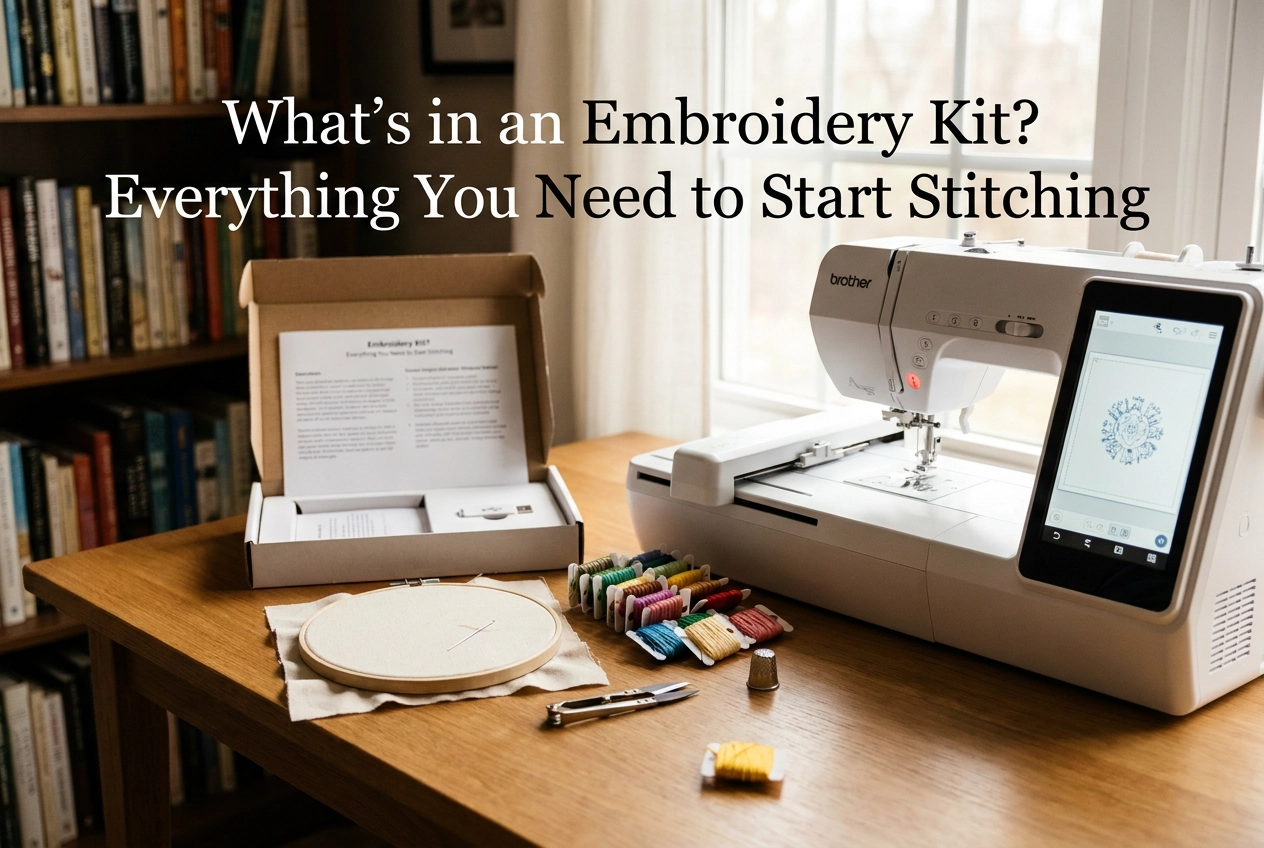
So you've decided to try embroidery. Maybe you saw a gorgeous hoop hanging on someone's wall, or you stumbled across a satisfying stitch video online and thought, "I could do that." The good news? You absolutely can, and the best place to start is with a good embroidery kit.
But if you've never picked up a needle and thread for this kind of craft before, you might be wondering what exactly comes inside one of these kits. Do you need anything extra? What's the difference between all those tiny tools? It can feel a little overwhelming at first, which is completely normal.
That's exactly why we put this guide together. Whether you're eyeing your first purchase or you already have a kit sitting on your desk waiting to be opened, we're breaking down every single item you're likely to find inside. By the end of this list, you'll know what each piece is, what it does, and why it matters for your stitching journey. Consider this your friendly, beginner approved tour of everything an embroidery kit has to offer.
The Basic Components of a Hand Embroidery Kit
If you're just getting started with hand embroidery, understanding what goes into a good starter kit makes the whole experience smoother and a lot more fun. Most beginner embroidery kits bundle five core components together, and knowing what each one does helps you stitch with more confidence from day one.
1. Embroidery Hoops
The hoop is what keeps your fabric taut while you stitch, and it makes a bigger difference than beginners expect. Wooden and bamboo hoops are the most popular choice for newcomers because they grip fabric firmly, stay put during stitching, and are easy to find at affordable prices. Starter bundles like the INSCRAFT 304 Pack Embroidery Kit include five bamboo hoops so you can work multiple projects at once. Plastic hoops are a lighter-weight alternative that some stitchers prefer for delicate or stretchy fabrics because they can hold tighter tension without leaving marks.
2. Fabric
Aida cloth is the go-to fabric for beginners, and for good reason. Its open grid weave acts as a built-in guide, showing you exactly where to place each stitch so you spend less time counting and more time actually stitching. Once you build confidence, linen and evenweave fabrics open up finer, denser stitch work with a more polished finished look.
3. Needles and Thread
Six-strand cotton embroidery floss is the standard thread for hand embroidery projects. Most patterns call for two or three strands at a time, which means your needle size needs to match. A size 5 needle handles two to three strands well, while thicker thread combinations need a larger eye, like a size 3. The Embroidery Guild of America's beginner fabric guide is a helpful reference for pairing thread weight with the right fabric count.
4. Pattern or Design Template
Every beginner kit needs a pattern to follow. Pre-printed fabric panels are the easiest starting point because the design is already on the cloth, no transfer steps required. Iron-on transfer designs and printed paper patterns are also common in starter kits from brands like Bucilla and Janlynn, giving you flexibility depending on your project fabric.
5. Scissors and Finishing Tools
Small, sharp embroidery scissors are non-negotiable for clean thread cuts close to the fabric. A seam ripper helps you remove stitches without damaging the cloth when you need to correct a mistake. Many complete kits also include a needle minder, a small magnetic accessory that keeps your needle handy between stitches and prevents that frustrating moment of losing it mid-project.
Machine Embroidery Kits: What Changes and What You Still Need
Once you move from hand embroidery to machine embroidery, the toolkit looks completely different. Gone are the wooden hoops you hold in your lap and the six-strand cotton floss you split by hand. Machine embroidery kits swap those out for machine-specific hooping frames that attach directly to your machine's arm, thread cones wound for mechanical tension systems, and one supply that beginners almost always underestimate: stabilizer.
Stabilizer is the unsung hero of every clean machine embroidery result. It's the backing material that keeps your fabric from shifting, puckering, or stretching while the machine lays down thousands of stitches. Cutaway stabilizer stays permanently bonded beneath the design and works best for stretchy knits and dense stitch counts. Tearaway stabilizer removes cleanly after stitching and suits stable woven fabrics like quilting cotton or denim. Water-soluble stabilizer dissolves when wet, making it ideal for freestanding lace, sheer fabrics, or any project where visible backing would ruin the finished look. Choosing the wrong type is one of the most common reasons a beginner's first machine project comes out puckered or distorted.
Thread is another big shift. Machine embroidery runs on 40-weight polyester or rayon thread, not the thick, divisible cotton floss from a hand kit. Polyester holds up better through washing and UV exposure, while rayon offers a silkier sheen for decorative work. Tension settings also vary by fabric weight and design complexity, so expect a learning curve as you dial things in.
Here's where most physical machine embroidery kits fall short, though. They'll bundle the hoops, the bobbins, and maybe a few thread spools, but they leave out the one thing your machine actually needs to stitch: the digital design files. Your machine cannot stitch without a file, and with the embroidery machine market projected to surpass USD 8.12 billion by 2035, millions of machine owners are actively hunting for ready-to-use designs the moment their machines arrive. That's exactly the gap a digital design library fills, giving you an instant, searchable catalog of files sized, formatted, and ready to stitch from day one.
Types of Embroidery Kits Matched to Skill Level
Not every embroidery kit is built for every crafter, and matching the right kit to your current skill level makes a huge difference in how much you enjoy the process. Here is a quick breakdown of the main kit types you will encounter and who each one is actually designed for.
Beginner Hand Embroidery Kits
These are the friendliest entry point into the craft. A typical beginner embroidery kit includes a pre-printed pattern stamped directly onto fabric so you always know exactly where to stitch, a plastic or wooden hoop to keep your fabric taut, and a small selection of floss colors. The goal is to get you comfortable with foundational stitches like the backstitch, satin stitch, and French knot before anything else. Many kits cover around 10 to 13 basic stitches, which is genuinely enough to complete beautiful finished pieces. Hand stitching has also picked up steam as a mindful hobby in 2025, with many new crafters drawn to it specifically for the slow, focused quality of the work. According to top crafting trends for 2025, stress relief and mindful making are now core reasons people pick up needle and thread for the first time.
Intermediate Kits
Once you have mastered basic stitches, counted cross-stitch sets and needlepoint canvas kits are the natural next step. These formats require you to read a symbol chart, count threads or canvas squares, and manage color sequencing on your own without a pre-printed guide holding your hand. Specialty thread packs featuring bold, vibrant palettes are increasingly popular at this level, reflecting a broader 2025 trend toward maximalist embroidery with bright colors and layered techniques.
Machine Embroidery Starter Setups
A machine embroidery kit typically bundles the machine itself with a few hoop sizes, a stabilizer sampler, and a basic thread palette. One important thing to know: the design files included in most starter machine setups are limited to simple demos. They exist to verify the machine works, not to inspire real projects. That is exactly why pairing any machine gift with a downloadable design bundle is such a practical move. You get immediate access to a full library of ready-to-stitch files without waiting.
Gift-Oriented Kits and the Bigger DIY Picture
Embroidery kits of every type consistently rank among popular gift choices, with search interest spiking around birthdays and the holiday season. The 13 best fiber craft kits for adults lists confirm how strong consumer appetite is for curated, giftable craft sets. Broader market data supports this too: the DIY craft resurgence is a sustained growth driver projected to run through 2025 to 2034, bringing fresh hobbyists into embroidery at every skill level and expanding demand across both hand and machine kit categories continuously.
What Most Machine Embroidery Kits Leave Out: Design Files
Here is something most machine embroidery kits simply forget to mention: your machine cannot stitch a single motif without a digitized design file. Thread, stabilizer, and a hoop are all essential, but without the actual file telling your machine where every needle movement goes, how many stitches to lay down, and when to trim or change thread colors, you have an expensive piece of equipment sitting idle. Think of the design file as the brain of the whole operation. A regular JPG or PNG image won't work either; as explained in this guide to machine embroidery file formats, a normal image only shows what something looks like, while an embroidery file tells the machine exactly how to recreate that image with thread. Those are two completely different things, and converting one to the other is a skilled process called digitizing, not a simple file rename.
File Format Compatibility Matters More Than You Think
Before you download any design file, you need to know your machine's native format. The most common ones are DST (Tajima, broadly compatible across many machines), PES (the standard for Brother home machines), JEF (Janome's native format), XXX (Singer machines), and HUS (Husqvarna Viking). There are also formats like VP3, EXP, and SEW floating around, so the landscape can feel a little fragmented at first. Always check your machine's manual or manufacturer site to confirm exactly which format it reads before you purchase or download anything. Using the wrong format can mean a design simply won't load, or worse, it stitches incorrectly.
Instant Downloads Beat Waiting for Shipping
One of the biggest practical advantages of downloadable design files is that you can start stitching the same day. No shipping window, no waiting on a package, no running out of a physical product. The moment your purchase goes through, the file is in your inbox and ready to transfer to your machine via USB or memory card. That kind of immediacy is genuinely hard to beat, especially when you're mid-project and realize you need a specific design right now.
A Digital Library Offers Themes No Boxed Kit Can Match
A quality digital design library stretches into territory no physical kit even comes close to covering. Sports team logos, NFL and college athletics, seasonal and holiday motifs, anime and cartoon characters, children's themes, country flags, monogramming fonts, and nature designs are all available in one place. Embroiderynsewing.com organizes its catalog by theme and category so you can quickly locate the right design for a youth sports jersey, a personalized holiday gift, or a fandom-inspired project and download it in your machine's correct format immediately, without hunting across multiple sites or waiting on custom digitizing.
How to Choose the Right Embroidery Kit for Your Goals
Picking the right embroidery kit comes down to three things: how you want to create, how much you want to spend, and what you actually plan to make. Getting clear on those three questions makes the decision pretty straightforward.
Start with the hand vs. machine question. If you want a portable, relaxing hobby that costs very little to start and requires zero tech setup, a hand embroidery kit is the obvious choice. Grab your hoop, thread your needle, and you are stitching within minutes. But if you are thinking bigger, producing multiple pieces, personalizing apparel, or building an Etsy-style side business, machine embroidery is the scalable path. A machine setup paired with a solid digital design library lets you stitch the same design dozens of times with consistent results, which hand embroidery simply cannot match at volume. The Ultimate Beginner's Guide to Embroidery Kits breaks this distinction down clearly for anyone still weighing both options.
Budget shapes the decision just as much as your goals. Starter hand kits typically land well under $30, making them easy impulse buys or low-risk gifts. Machine setups require a larger upfront investment in the hardware itself, with home-use machines generally starting in the hundreds of dollars. The good news for machine owners is that digital design downloads sit in a completely different price tier. Individual files are priced in the impulse-purchase range, so building a large, varied design library happens gradually without any single purchase feeling like a big commitment.
Think about project scope before you buy. A single decorative hoop project is exactly what hand kits are designed for. Custom team gear, boutique apparel decorating, or any kind of production volume calls for machine embroidery backed by ready-to-stitch digital files. You can browse Amazon's Best Sellers in Embroidery Kits to get a quick read on what beginner kits currently look like and what they include.
Gifting is worth factoring in too. Embroidery kits are consistently strong craft gifts, especially during the holiday season. For machine owners specifically, pairing a physical supply bundle with a downloadable design pack gives the recipient something to stitch immediately, which makes the gift feel complete rather than just a starting point.
The timing is genuinely good for anyone getting into embroidery right now. The global embroidery hoop set market is growing at a CAGR of 6.8 to 7.0 percent through 2034 to 2035, reflecting real, sustained consumer enthusiasm for the craft. More products, more designs, and more community support are all flowing into this space, which benefits anyone just getting started.
Popular Design Themes to Build Your Machine Embroidery Library
Once your machine is set up and your stabilizer is loaded, the next big question is: what are you actually going to stitch? Building a solid design library is what separates a machine that collects dust from one that runs every weekend. Here are the five categories worth prioritizing first.
1. Sports and Fandom Designs
Sports and fandom embroidery files are among the most searched categories for a reason. Makers producing custom jerseys, hats, spirit wear, and fan gear consistently look for NFL team motifs, college athletics files, and university-inspired designs. If you know anyone who bleeds their team's colors, you already understand the demand. A well-stocked sports library lets you turn around game-day projects quickly without waiting on custom digitizing.
2. Seasonal and Holiday Themes
Seasonal designs are your year-round revenue stream if you sell, or your year-round creative outlet if you craft for fun. Christmas and Halloween are the obvious heavy hitters, but spring florals, Valentine's Day motifs, and Fourth of July patriotic themes all have their moment. Staying current with the season keeps your projects feeling fresh and gift-ready.
3. Children's Characters and Kids' Motifs
Kids' themes are perennial bestsellers. Cartoon characters, anime designs, unicorns, dinosaurs, and playful animals are perfect for personalizing backpacks, onesies, and school supplies. According to trending embroidery design research for 2026, baby and children's embroidery represents some of the highest demand in the market right now.
4. Fonts, Monograms, and Alphabets
Monogram alphabets and embroidery fonts are the backbone of any boutique apparel business or Etsy shop. Name personalization and initial embroidery are fast sellers that never go out of style. A strong font library means you can fulfill custom name orders on demand without starting from scratch every time.
5. Nature, Flags, and Transportation Motifs
Rounding out a versatile library means covering the requests you did not expect. Nature motifs, botanical florals, country flags, and transportation designs like trucks, planes, and trains give you flexibility across a wide range of custom project types and customer demographics.
Frequently Asked Questions About Embroidery Kits
What does a beginner embroidery kit include?
A standard beginner embroidery kit typically contains five core items: an embroidery hoop, a fabric piece (often pre-printed with the pattern already traced), embroidery floss in several colors, a needle, and a basic instruction sheet. Some kits from specialty suppliers also include pre-sorted floss on color-coded thread cards and a small pattern booklet, which makes the whole setup feel a lot less overwhelming. Machine embroidery starter kits are a different story. They swap the floss and pre-printed fabric for stabilizer, machine-specific thread, and sometimes an accessory hoop sized for your machine's throat. The one thing many machine kits leave out entirely is design files, so always check before you buy.
What file formats do embroidery machines use?
The five formats you will encounter most often are PES (Brother), DST (Tajima, widely considered the universal format), JEF (Janome), XXX (Singer), and HUS (Husqvarna Viking). Each brand reads its own format, so downloading the wrong one means your machine simply will not recognize the file. At Embroidery n Sewing, designs are available across multiple formats from a single product page, so you just pick the one that matches your machine and download instantly.
Can I use downloadable designs with any embroidery machine?
Yes, as long as you select the format that matches your specific machine brand. Most digital design libraries offer the same motif in several formats simultaneously, so one purchase covers you regardless of which machine sits on your table. Just confirm your machine's accepted format in the owner's manual before you download.
Are downloadable designs better than built-in designs?
Built-in designs are capped at whatever the manufacturer decided to pre-load, and that library never grows. A downloadable design collection gives you access to thousands of themes that are updated regularly, spanning sports teams, seasonal motifs, anime, florals, and much more. No bundled kit can compete with that kind of variety.
Is embroidery a good hobby to start in 2026?
Absolutely. According to the 2026 embroidery kit trend guide from Royal Chou, the market is expanding steadily, driven by DIY crafting culture, demand for personalized apparel, and a vibrant online maker community. The global embroidery machine market is projected to surpass USD 8.12 billion by 2035, which tells you just how many people are already stitching. Whether you are a hobbyist, a small-business maker, or someone looking for a relaxing creative outlet, 2026 is a genuinely great time to start.
Your Embroidery Kit Is Just the Starting Point
Your embroidery kit gets you in the door, but your design library is what keeps the creative momentum going. Once your machine is threaded and your stabilizer is loaded, the only thing standing between you and a finished project is the right design file. Think of downloadable designs less like a one-time purchase and more like an ongoing supply, just like thread or stabilizer. Every new project calls for a new file, and that is actually one of the most exciting parts of machine embroidery.
That is where having a well-stocked, easy-to-browse catalog makes all the difference. Embroiderynsewing.com covers an impressive range of categories including sports teams, fandom designs, seasonal themes, children's motifs, embroidery fonts, and nature patterns. Whether you are making a personalized baby onesie, a custom team jacket, or a holiday gift, there is a relevant design ready to download right now.
Browsing by category is the fastest way to match a design to your next project brief. Pick the theme that fits, grab the file, and you will be amazed how quickly your embroidery kit transforms from hardware into something genuinely finished and personal. Start today.
Conclusion
Embroidery kits are thoughtfully designed to give you everything you need right from the start. From the fabric and hoop to the needles, thread, and pattern, each component plays a specific role in helping you create something beautiful. Understanding what each tool does removes the guesswork and lets you focus on the fun part: actually stitching.
The learning curve is gentler than you might think, especially when you start with the right supplies already in hand. You do not need a background in sewing or art to pick this up and enjoy it.
Now that you know what to expect inside your kit, it is time to put that knowledge to use. Open the box, lay out your supplies, and take that first stitch. Every skilled embroiderer started exactly where you are right now, and the only thing left to do is begin.