Have you ever stood in a craft store staring at a wall of colorful thread, completely overwhelmed and unsure where to even begin? You are definitely not alone. Choosing the right embroidery thread can feel like a mystery when you are just starting out, but it does not have to be!
The truth is, not all embroidery thread is created equal. Different threads are designed for different purposes, and using the right one can make a huge difference in how your finished project looks and feels. From silky smooth options that catch the light beautifully to sturdy threads built to handle heavy-duty projects, there is a whole world of choices waiting for you to explore.
In this guide, we are breaking down the most common types of embroidery thread that every beginner machine embroiderer should know about. By the time you finish reading, you will feel confident enough to pick the perfect thread for your next project without second-guessing yourself. Let's dive in and take the mystery out of your thread collection once and for all!
Why Embroidery Thread Choice Makes or Breaks Your Design
If you've ever stitched out a design and ended up with broken threads, muddy colors, or patchy coverage, there's a good chance your thread was the culprit. Not your machine. Not your digital design file. Your thread. This is one of the most overlooked fundamentals in machine embroidery, and getting it right from the start saves you serious time, money, and frustration.
The global embroidery thread market tells its own story here. Valued at approximately USD 8.15 billion in 2025 and projected to reach USD 13.45 billion by 2033 at a CAGR of 6.46%, the industry is booming because demand for personalized, decorated textiles in apparel and home decor has never been higher. People want custom, they want beautiful, and they want it to last through the wash.
Thread selection directly controls whether your finished piece actually delivers on all three. The right thread gives you crisp stitch definition, vibrant color, and solid coverage that holds up over time. The wrong thread gives you headaches.
Here's something beginners often don't realize: machine embroidery thread is engineered completely differently from hand embroidery floss. Machine thread has a tighter twist, lighter weight, and smoother finish specifically designed to flow cleanly through tension systems at high speed. Hand embroidery floss is looser, thicker, and meant to be separated by hand. Load hand floss into your machine and you'll get constant breaks, and it has nothing to do with your digitized design file quality.
Understanding these basics before you stitch out your first downloaded design file is the difference between a successful first project and a frustrating afternoon of re-hooping.
Thread Material Types and How Each Performs on a Machine
Not all embroidery thread is created equal, and the material your thread is made from will directly shape how your machine handles it, how your finished design looks, and how long those colors last after washing. Here is a breakdown of the six main thread types you will encounter, starting with the one that dominates the market for good reason.
Polyester is the go-to choice for machine embroidery, and the numbers back that up. It holds 46.7% of global embroidery thread revenue and is used in an estimated 80% of all machine-embroidered products. The reason is simple: polyester is tough. It delivers consistent tensile strength, resists fading through repeated washes, and holds up against bleach and high-heat drying without losing its color or structure. If you are personalizing team apparel, tote bags, or anything that will see a washing machine regularly, polyester is your most reliable starting point.
Rayon is the shiny alternative. It produces a brilliant, silk-like luster that genuinely pops on decorative apparel and boutique projects. The tradeoff is durability. Rayon fades faster under UV exposure and has lower tensile strength than polyester, meaning it is more prone to breakage when machine tension is too high. Think of rayon as a great choice for display pieces, framed art, or garments that will not be washed often, rather than everyday wearables.
Cotton thread has a classic matte finish that works beautifully for quilting and heirloom-style projects. However, cotton runs thicker and softer than standard machine embroidery thread, which means it can affect stitch density in your design file and produces more lint during stitching. It is not the smoothest performer on a machine, but for denim or vintage-inspired work, the texture is worth it.
Metallic thread is where things get technical. That reflective, festive finish is perfect for holiday designs, sports logos, and fandom projects, but metallic thread is the most demanding material to run. You will need to slow your machine speed down, switch to a large-eye metallic needle, and consider using a thread lubricant like Sewer's Aid to reduce fraying and breakage.
Silk offers the finest luster of any thread type, but its cost and delicate handling make it a specialty material rather than an everyday choice for home machines. Finally, wool and specialty fibers like linen are primarily hand embroidery materials. Their bulk and unpredictable behavior under machine tension systems make them impractical for most home embroidery setups. For a deeper look at how these materials compare in real machine conditions, this machine embroidery thread guide breaks down performance by type with practical detail.
Polyester vs. Rayon: Which Should You Use for Machine Embroidery?
When you're stocking up on embroidery thread for machine work, this is the comparison that comes up more than almost any other. Both polyester and rayon are legitimate choices, but they perform differently in the real world, and picking the right one upfront saves you a lot of frustration at the hoop.
Polyester is your safest all-around starting point. It runs smoothly at high speeds, resists thread breaks, and holds up beautifully through repeated washing. If you're stitching NFL logos onto fleece pullovers, decorating kids' backpacks, or personalizing team jerseys that will go through the laundry every week, polyester is the clear winner. It's colorfast, can withstand bleach exposure, and doesn't fade the way some lower-quality threads do after a dozen washes. Polyester actually dominates the global embroidery thread market for good reason, holding roughly 46.7% of market revenue. That popularity reflects real-world reliability across machine brands and fabric types.
Rayon shines in low-wash, high-visibility applications. It has a slightly silkier feel and a luminous sheen that can make fine design details look extra polished on decorative pieces, framed embroidery, or display garments that won't face heavy laundering. If you want that extra visual pop on a heirloom-style project or a boutique decorative item, rayon delivers. The tradeoff is durability; it needs gentler handling.
Tension behavior is where they differ most on the machine. Rayon is softer and more pliable, so it can loop or pucker if your tension isn't dialed in. Polyester tends to run predictably on most machine defaults, making it more forgiving for beginners still learning to adjust settings.
Color range is no longer a reason to choose rayon over polyester. Modern trilobal polyester has a sheen that directly matches rayon, and both types now offer hundreds of colors with comparable richness.
For stitching downloadable sports, school, or fandom designs onto cotton or fleece, polyester is the recommended default. The combination handles regular wear and washing reliably, keeping your designs looking sharp long after the first stitch-out.
Understanding Thread Weight and Why It Affects Your Stitch Results
Thread weight is one of those variables that beginners often overlook, and it genuinely makes a bigger difference than most people expect. The numbering system is counterintuitive at first: a higher number means a finer, thinner thread, while a lower number means a thicker, heavier one. Think of it like this, the number represents how many meters of thread it takes to reach a standard weight. More meters per gram equals finer thread. Once that clicks, the whole system makes sense.
40-weight thread is the industry standard for machine embroidery, and it's the weight that most downloadable design files are digitized for. It strikes the right balance between coverage, detail, and stitchability at typical stitch densities, which is exactly why it's the default. If you're just getting started and not sure what to grab, 40-weight is your answer the vast majority of the time. You can learn more about how weight classifications work at Thread Weight on SuperiorThreads.com.
60-weight thread is noticeably finer and works well for small lettering, intricate detail areas, and delicate or lightweight fabrics. When heavier thread would overwhelm a fine design element or cause distortion on a thin fabric, 60-weight gives you more control and a lighter hand. It's also the standard choice for bobbin thread, which tells you a lot about how fine it actually is relative to what goes through the needle.
On the other side of the scale, 30-weight and 12-weight threads are thicker and more textured. These weights are a great fit for bold monograms, large fill sections, or any project where you want that chunky, almost hand-stitched look. The finished result has real visual weight and dimension.
Here's the critical part that catches a lot of beginners off guard: your thread weight has to match the stitch density built into your design file. A file digitized for 40-weight has a specific stitch count calibrated for that thread size. Load 60-weight thread into the same file and the coverage will look thin and sparse. Load 30-weight and the stitches start stacking on each other, creating stiffness and potentially distorting your fabric. The thread and the file are a matched pair, not interchangeable variables. For a thorough breakdown of this relationship, this guide to thread weights in machine embroidery is worth reading before you start a new project.
When you're browsing and purchasing downloadable embroidery design files, always check whether the digitizer lists a recommended thread weight in the product description. Professional digitizers set stitch density, underlay, and pull compensation based on a specific thread weight. That recommendation is a functional instruction, not a casual suggestion.
One final thing worth flagging: Cotton Perle (also called Pearl cotton) is not a machine embroidery thread. It's a non-divisible, twisted thread used for hand embroidery, available in weights 3 through 12. Its twisted structure and bulk make it incompatible with the needle and tension system of most home embroidery machines. If you see it in a craft store, it belongs on a hand embroidery project, not in your machine's spool pin.
Top Machine Embroidery Thread Brands Worth Knowing
Once you understand thread materials and weights, the next natural question is which brands actually deliver on their promises. A few names come up consistently in machine embroidery circles, and knowing what each one does well will save you time and money as you build your thread collection.
1. Isacord is widely considered the gold standard for both home and commercial machine embroidery. Their 40-weight, 100% polyester thread comes in over 400 colors, and the colorfastness and batch-to-batch consistency are genuinely hard to beat. What makes Isacord especially beginner-friendly is the numbering system. When you download a design file that includes a color change sequence, those stop numbers are often listed in Isacord codes, which makes it straightforward to pull the right spool without second-guessing yourself. For anyone stitching downloadable designs regularly, that alone is a huge workflow win. You can find a detailed breakdown of Isacord's performance across project types if you want to dig deeper.
2. Madeira is another top-tier name worth stocking. Their Polyneon polyester line and Rayon 40 series give you options depending on the look you're going after, and the brand has a strong reputation for reliable tension behavior across major home embroidery machine brands. If you've ever dealt with thread looping or puckering, you'll appreciate a brand that plays well with your machine's tension settings right out of the box. The color vibrancy on Madeira's polyester line is particularly impressive for bold, graphic designs.
3. Sulky is the brand to reach for when your design calls for something with sparkle or sheen. Beyond their solid 40-weight rayon and polyester lines, Sulky's Sliver and Holoshimmer metallic threads are popular choices for holiday-themed projects, seasonal decorations, and any design where light-catching texture is part of the look. Metallics can be trickier to work with at higher speeds, so slow your machine down slightly and the results are worth it.
4. Robison-Anton is a long-standing US brand that often flies under the radar with beginners but is very well-regarded by boutique decorators and small production shops. They produce both rayon and polyester 40-weight options with a rich, deep color palette and consistent quality that holds up across production runs.
5. A practical note on mixing brands: each brand uses its own color numbering system, and those numbers do not cross-reference directly between brands without a conversion chart. Sticking to one brand's color range while you're building your collection makes working through multi-color design sequences much smoother.
6. One thing beginners sometimes get confused about: DMC and Anchor are hand embroidery thread brands, and they are not substitutes for machine embroidery spools. They are engineered for hand stitching and will cause real problems if you try to run them through a machine.
Hand Embroidery Thread vs. Machine Embroidery Thread: Key Differences
If you've spent any time browsing craft stores or online communities, you've probably come across DMC and Anchor stranded cotton floss. These are the gold standard brands for hand embroidery, and for good reason. They offer exceptional color consistency, strong colorfastness, and a library of over 500 numbered shades that hand stitchers have relied on for decades. But here's the thing: those qualities are engineered entirely for hand application. Neither DMC nor Anchor floss belongs anywhere near your embroidery machine's needle or bobbin, no matter how perfectly a color matches your project.
The reason comes down to how stranded cotton is built. Each skein contains six individual strands twisted loosely together, and hand embroiderers routinely split those down to just one or two strands for detailed work. That flexibility is a feature for hand stitching. For a machine, it's a structural problem. Your embroidery machine feeds thread through a precise path of guides, tension discs, and a take-up lever, all calibrated for thread that behaves consistently under mechanical tension. Loosely twisted, divisible floss has no tension memory and no consistent feed behavior, so the machine simply cannot process it reliably.
This gets to a bigger packaging difference that beginners often miss. Machine embroidery thread comes wound onto spools or cones under controlled tension, specifically so it unwinds smoothly during mechanical stitching. Hand embroidery floss comes in small skeins or hanks meant to be pulled gently by hand. If you try to run floss through a machine anyway, expect thread breaks, shredding, and erratic tension. In a worst case, you risk damaging the tension discs themselves, which is an expensive repair.
This distinction matters a lot if you're working with downloadable design files. Digital embroidery formats like .DST, .PES, .JEF, and .EXP are digitized specifically for machine execution, with stitch paths and density values that assume spool-wound machine thread. No amount of color-matching with hand floss will change that mechanical reality. When you purchase and download a design file, always pair it with proper machine embroidery thread on a spool or cone. Check out DMC Embroidery Threads: How They're Made and Whatnot for a deeper look at how hand embroidery thread is actually constructed, which makes the machine incompatibility even clearer.
How to Match Thread Colors to Your Downloadable Design Files
When you download a machine embroidery design file, one of the most useful things included in that package is the color sequence list. This is essentially a roadmap for your project, showing you the exact order of thread changes and often calling out a specific brand and color number for each stop. You might see a reference like Isacord 0020 (a bright white) or Madeira Polyneon 1713, giving you a precise starting point rather than a guessing game. Professionally digitized files are built this way on purpose, because color accuracy is baked into the design from the beginning.
Of course, you may not stock every brand referenced in every file you download. That's completely normal, and it's why cross-reference charts exist. Major thread brands including Isacord, Madeira, Sulky, and Robison-Anton all publish color conversion resources that let you find the closest equivalent number in your preferred brand. If the file calls for an Isacord color and you run Madeira, a quick cross-reference gets you to the nearest match without starting from scratch. This kind of color theory for embroidery thinking is something worth developing early as a machine embroiderer.
For designs tied to recognizable themes, this precision really matters. Sports team logos, school colors, and national flag patterns have defined color standards that audiences immediately recognize. If you substitute a slightly different navy or gold, the finished piece can look off even if you can't immediately pinpoint why. Following the branded color numbers in the file sequence is the straightforward way to make sure your NFL jacket patch or university hoodie looks exactly right. A visual guide to choosing thread colors can also help you understand why certain shades read so differently once stitched.
One thing that surprises a lot of beginners is that thread looks different on the spool than it does stitched out. The reason is simple: stitches stack thread at an angle on the fabric surface, which compresses and layers the fibers in a way that shifts the perceived color. A spool that looks bright coral can stitch out as a muted salmon. Always run a test swatch on the same fabric you plan to use before committing to a full project. This one step saves a lot of frustration.
Building an organized thread stash sorted by brand color number, rather than loosely by color family, makes multi-color designs much easier to manage. Anime characters, cartoon logos, and sports crests often carry 8 or more color stops, and hunting through a disorganized bin adds real time to every project. When your spools are numbered and sorted, you can pull the whole thread lineup from the file sequence before you even hoop up.
Designs from a well-stocked catalog like embroiderynsewing.com typically include the color sequence right in the download package, so you have everything you need to pull your spools, load your machine, and start stitching with confidence.
Thread Forms Explained: Spools, Cones, and Hanks
Beyond material and weight, the physical form your embroidery thread comes in matters more than most beginners realize. Getting familiar with the different formats will save you from buying the wrong thing and help you build a collection that actually fits how you stitch.
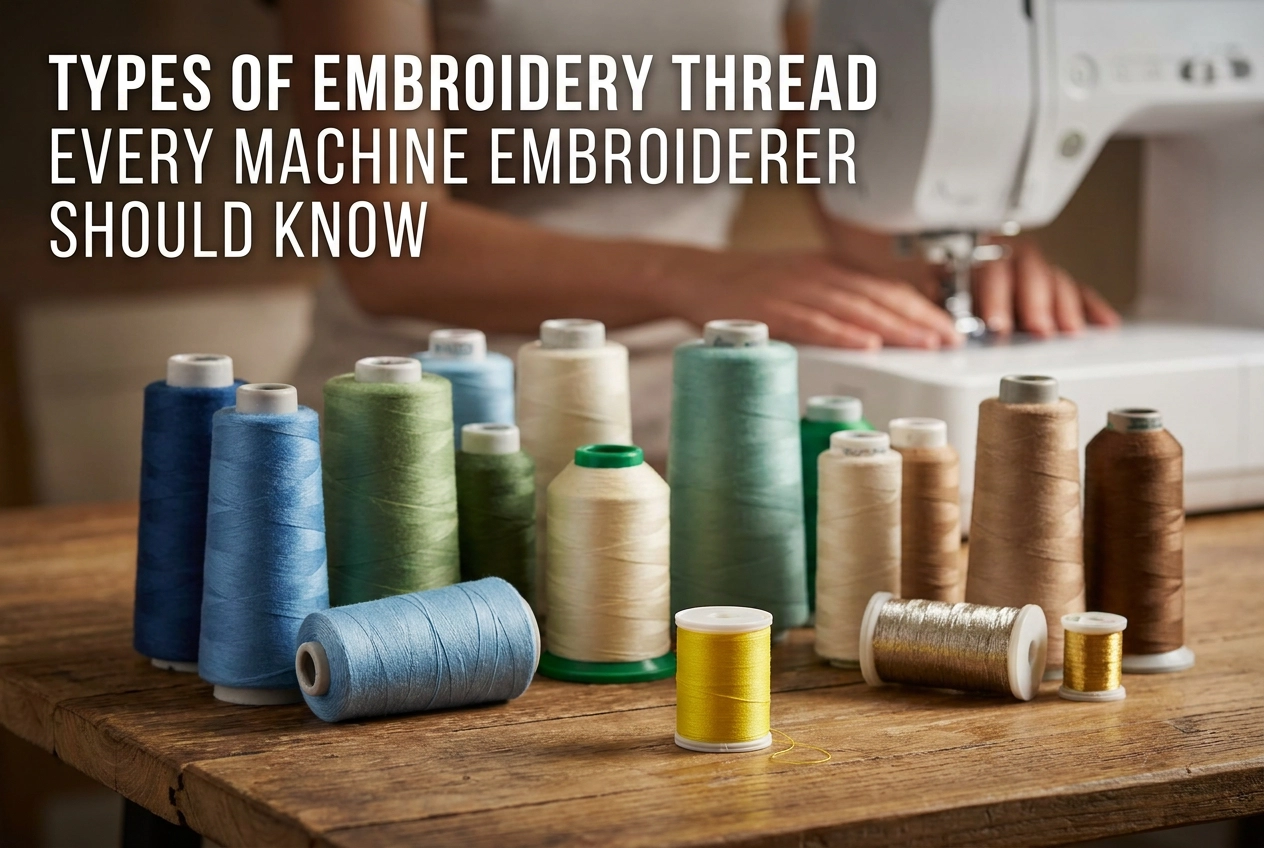
Spools are the format you'll encounter most often as a home machine embroiderer. They hold anywhere from 200 to 1,000 meters of thread depending on the brand and thread weight, and they're designed to sit on both vertical and horizontal spool pins without any special adapter. If you're shopping for machine embroidery thread and you're just getting started, spools are your default. They're easy to store on a thread rack, simple to swap mid-project, and widely available across weight and color ranges.
Cones are a different story. These tall, tapered spools typically hold between 3,000 and 5,500 meters of thread, which makes them the go-to format for commercial embroidery machines and small production shops. At that volume, stopping to change a spool every few hundred meters would kill productivity. For home embroiderers, cones aren't usually necessary, with one exception worth noting. If you stitch white or black constantly, whether for background fills, lettering, or stabilizing stitches, switching just those colors to a cone can seriously cut down on mid-project interruptions. You'll need a thread stand to use a cone on a home machine, since the thread has to feed vertically from a stationary base rather than spinning off a spool pin.
Hanks and skeins are firmly in hand embroidery territory. Stranded cotton like DMC six-strand floss and Pearl cotton both come in hank form, as covered in this guide to cotton hand embroidery threads. These are not machine-ready formats. Before you could use a hank on a machine, you'd need to wind it onto a spool or bobbin first, which adds a step most machine embroiderers simply skip by buying thread in the right format to begin with.
Thread cakes, the cylindrical center-pull format you've probably seen in knitting and crochet aisles, occasionally show up in specialty thread lines. If you encounter one, know that it also requires a thread stand rather than a standard spool pin. They're uncommon in machine embroidery and not something a beginner needs to think about right away.
For most people building a starter thread collection, the practical advice is simple: stock small to medium spools first, get comfortable with your machine and the projects you love, and only move toward cones once you've identified a color you're consistently running out of.
Choosing the Right Thread for Common Machine Embroidery Projects
Now that you've got a solid handle on thread materials, weights, and forms, it's time to put that knowledge to practical use. Different project types genuinely call for different thread choices, and matching your embroidery thread to the job at hand is one of the fastest ways to level up your results.
Sports and Team Apparel
For jerseys, hats, bags, and any gear that's going to see regular washing, 40-weight polyester is your best friend. It holds up through repeated wash cycles without fading, keeps those team colors looking sharp against dark fabrics, and maintains its structure in the dense fill stitching that logo-style designs require. When you're working from a downloadable sports or NFL team design file, try to match your thread colors as closely as possible to the actual team palette. Many professional embroiderers use thread color charts from brands like Isacord or Madeira to get those matches tight.
Children's Clothing and Gear
Kids are hard on their clothes, which means your thread needs to be equally tough. Polyester wins again here for its resistance to color bleeding, shrinkage, and general wear. One helpful tip for children's name and monogram designs: step down to a 60-weight polyester for small lettering. The finer thread allows cleaner needle penetration on tiny letter forms and reduces the puckering that heavier thread can cause on small stitched text. Pair it with a 75/11 sharp needle for the best results on those detail areas.
Seasonal and Holiday Projects
Ornaments, stockings, and table runners are where metallic thread really shines, literally. The key is slowing your machine speed down, switching to a size 90 metallic needle, and using a thread net or a drop of sewing lubricant on the spool if you're getting breakage. Metallic thread is a little fussier than polyester, but the festive payoff is worth it. For a deeper breakdown of thread types by category, this quick guide from Kimberbell is genuinely useful.
Home Decor Projects
For throw pillows, tote bags, and framed embroidery that will live on display rather than run through the laundry constantly, rayon thread delivers a beautiful high-sheen finish that polyester simply cannot replicate. Rayon is more delicate and less wash-fast, so it's best reserved for decorative items. Note that rayon is also sensitive to high heat, so avoid aggressive ironing directly on stitched areas.
Anime, Cartoon, and Fandom Designs
These designs typically feature bold outlines and large solid fill sections, and keeping those color blocks clean is everything. Consistent 40-weight polyester is the right call here because it gives you reliable coverage and prevents color from bleeding visually into adjacent sections. Proper underlay stitching in your design file also helps keep those boundaries crisp. Hatch Embroidery's thread selection guide covers how digitizing choices interact with thread performance if you want to explore that further.
University and College Logo Designs
Collegiate logos are detail-heavy, often combining tight satin columns with fine text that needs precision to read cleanly. Quality 40-weight polyester is the industry standard for this application. One practical habit worth building early: replace your embroidery needle after every three to four projects. A dull needle drags through fabric instead of piercing cleanly, and you will see that degradation immediately in your satin stitch quality. Sharp needle, quality thread, and a good design file make all the difference on logos with fine detail.
Storing and Caring for Your Embroidery Thread Collection
Once you've invested in a solid thread collection, protecting that investment becomes just as important as building it. Thread degrades faster than most beginners expect, and the culprits are surprisingly ordinary: sunlight streaming through a craft room window, humidity from a bathroom nearby, or dust settling on spools that sit out in the open. Storing your thread in closed drawers, dedicated thread cabinets, or lidded boxes away from direct sunlight makes a genuine difference in how long your colors stay vibrant and your fibers stay strong. Think of it the same way you'd think about storing fabric or ink, because light and moisture are equally destructive to all of them.
Material matters a lot when it comes to storage sensitivity. Rayon thread is particularly vulnerable to humidity and prolonged UV exposure, both of which can cause fibers to become brittle and colors to shift over time. Polyester is considerably more stable under varying conditions, which is one more reason it tends to be the go-to choice for heavy machine embroidery use. If your collection leans rayon-heavy, keeping those spools in a climate-controlled space with relative humidity between 40% and 55% is worth the extra attention. A few silica gel desiccant packets tucked into your storage containers do a lot of work in humid climates. For a deeper look at thread preservation practices, this guide to embroidery thread storage covers environmental controls in thorough detail.
Metallic threads deserve their own category entirely. Heat accelerates the breakdown of the metallic core, which leads to shredding and snapping mid-stitch, and summer months in a warm craft room can be surprisingly harsh. Storing metallic spools in a sealed zip bag in the refrigerator during hot and humid months is a practical workaround that many experienced embroiderers swear by. Just let them return to room temperature before stitching to avoid condensation on the thread itself.
When it comes to organization, sort your spools by brand color number rather than by visual color. When you're working from a downloadable design file's color sequence list, those files reference specific thread numbers, not visual descriptions. Having your collection sorted numerically by brand means you can find the exact shade in seconds rather than scanning by eye across a rainbow-organized rack. It also helps avoid buying duplicates, which is a surprisingly common problem once a collection grows past a few dozen spools.
Finally, loose thread ends are one of the most frustrating and avoidable problems in thread storage. A free end snaking around neighboring spools creates tangles that can cause breakage the moment you load that thread onto your machine. Use small spool end clips or a short piece of tape to secure loose ends before putting spools away. It takes a few extra seconds per spool and saves a lot of frustration later.
How to Build a Starter Thread Collection for Machine Embroidery
Building a practical thread collection doesn't have to feel overwhelming. The key is starting with a focused, intentional foundation rather than grabbing random spools whenever inspiration strikes.
1. Start with 40-weight polyester in a core palette of 30 to 50 colors.
This is the standard starting point for home machine embroidery, and for good reason. Forty-weight polyester handles predictably, holds up through washing, and works with virtually every home machine's tension system without constant tweaking. Your core palette should cover neutrals like white, black, cream, and gray; true primaries; and common apparel colors such as navy, red, gold, forest green, and royal blue. Tuck in one or two metallic shades for accent work and you'll have a genuinely versatile starting lineup that covers most projects. According to beginner machine embroidery supply guides, thread selection is one of the first real supply challenges new embroiderers face, so a deliberate starting palette saves a lot of early frustration.
2. Let your design files drive your color purchases.
Before buying anything, look at the actual designs you plan to stitch. The color sequence lists inside your downloaded files will tell you exactly which shades get used most. If you're focused on sports team designs, match your favorite franchise or school colors first. That targeted approach means every spool you buy actually gets used rather than sitting on a shelf indefinitely.
3. Stick to one brand while you're learning.
Starting with a single quality brand like Isacord or Madeira keeps your color numbering system consistent. Design files reference specific thread numbers, and choosing the right thread for your machine projects becomes much simpler when you're working within one numbering system rather than juggling conversions between brands.
4. Double up on white and black immediately.
These two colors appear in nearly every multi-color design sequence. Running out of white halfway through a detailed logo stitch-out is one of the most common beginner frustrations, and it's completely avoidable. Add a second spool of each from the start.
5. Save specialty threads for later.
Metallic, neon, and glow-in-the-dark threads are genuinely exciting, but they require tension adjustments that beginners should tackle only after mastering standard polyester. Get comfortable with your machine first, then expand.
6. Browse design categories to spot your most-used color families.
Exploring themed collections at embroiderynsewing.com, whether sports, seasonal, or fandom designs, is a practical way to identify which color groups you reach for repeatedly. Let those patterns guide your next restocking order.
Putting It All Together: Thread Knowledge That Upgrades Every Project
You've covered a lot of ground in this guide, so here's the short version of everything that matters. 40-weight polyester is your everyday workhorse. It handles washing, resists fading, and plays well with virtually every machine and fabric combination you'll encounter. Rayon and metallic threads are deliberate upgrades for specific moments, not replacements. And stranded cotton floss from DMC or Anchor belongs in your hand-stitching kit, full stop. Loading it into a machine will cause tension problems and frustration.
The thread-to-design connection is real. Even a beautifully digitized downloadable file will underperform if you pair it with the wrong thread. The right 40-weight polyester on the right stabilizer turns even a simple design into something that looks sharp and finished.
Use your new knowledge as a pre-hooping checklist. Before you browse designs, ask yourself: What fabric am I using? How often will this get washed? Those two questions alone will point you toward the right thread every time. Check out the sports, seasonal, and fandom design libraries at embroiderynsewing.com to find ready-to-stitch files built for exactly the projects you're planning. Pick one reliable thread brand, build your core polyester palette around your favorite project themes, and always stitch a test swatch before running the full design.
Conclusion
Now that you know the most common types of embroidery thread, choosing the right one no longer has to feel overwhelming. Remember these key takeaways: thread type directly impacts your finished results, different materials serve different purposes, and matching your thread to your project is just as important as your design choice. Quality thread also makes a noticeable difference in durability and appearance over time.
The best way to build your confidence is to simply start experimenting. Pick up a few different thread types, run some test stitches, and see how each one performs on your machine. You will quickly develop a feel for what works best.
Your next beautiful embroidery project is waiting. Head to your local craft store or browse online, grab a few spools, and start creating. The perfect thread for your masterpiece is out there!